Wallet vs Exchange: The Difference, and Should a Beginner Use a Wallet?
Hanging around the community, beginners often get anxious from one line: "coins on an exchange aren't safe, move them to your own wallet quick." But you've only just learned to buy coins and haven't even figured out what a wallet is, so if you actually do it you're scared you'll lose your coins by accident. Relax. This piece first explains the difference between a wallet and an exchange clearly, then helps you judge: at your current stage, do you actually need to bother with a wallet?
01The difference in one line: who holds the key
Strip away all the jargon and the fundamental difference between a wallet and an exchange is a single line: does the platform hold the private keys, or do you?
You can roughly think of the "private key" as the master key that can move these coins. Whoever holds this key can truly command the coins.
- Exchange = custodial. The key is in the platform's hands. You log in with a username and password, and the platform safeguards your assets and keys for you, like depositing money in a bank.
- Self-custody wallet = self-custody. The key (in the form of a seed phrase) is in your own hands. The platform just gives you a management interface; it can't touch your coins, but you're fully responsible for security.
For exactly what private keys and seed phrases are, and what happens if you lose them, I wrote a dedicated piece, what are a seed phrase and a private key, and what happens if you lose them; this piece focuses on the trade-off between the two.
02What an exchange (custodial) is about
A centralized exchange like Binance works more like the bank / payment apps you're familiar with:
- You log in with a username and password, and if you forget the password you can go through recovery. This is friendly to beginners, unlike self-custody, where a lost seed phrase can't be saved by anyone.
- Buying and selling are convenient. Depositing, trading, and withdrawing all happen in one app, liquidity is good, and a beginner's first coin is basically always bought on an exchange.
- Assets are held by the platform. This is its advantage and its risk point: what you trust is this platform's security and operations. So choosing a reputable, large platform matters.
The most important thing you can do on an exchange is max out the account security settings, turn on two-factor authentication (2FA), set an anti-phishing code, and stay alert to fake apps and phishing sites. These are covered in the security setup to do after opening an account and how to spot fake exchange apps and phishing sites; do these well and keeping coins on an exchange day to day is workable for most beginners. For why 2FA matters, refer to the security notes in the official Binance Help Center; for the conceptual difference between custody and self-custody, Investopedia's custodial wallet entry explains it clearly too.
An exchange's convenience comes largely from "recoverability", forget the password and you can reset it. That's exactly what a self-custody wallet doesn't have. So don't dismiss the exchange right off the bat; its friendliness to beginners is for a reason.
While we're at it, let's puncture a common beginner misconception: many people assume "exchange custody" equals "unsafe" and "self-custody" equals "absolutely safe." It isn't so. The two models guard against different risks. An exchange guards against "you losing your own key", it holds it for you, and you can recover a forgotten password; its risk point is that you must trust the platform. Self-custody guards against "the platform's problems dragging you down", the key is in your hands and no one can touch it; but its risk point lands entirely on you, and once a seed phrase is mishandled, there's no do-over. So there's no standard answer for which is "safer," only "which risk you're better able to manage." A beginner is usually less able to withstand "losing your own seed phrase," which is exactly why starting with custody is recommended.
03What a wallet (self-custody) is about
A self-custody wallet (commonly a wallet app on your phone, or a hardware wallet) hands the key back to you:
- No username and password, only a seed phrase. The first time you create a wallet, it gives you a string of (usually 12 or 24) words, the seed phrase, the sole credential for restoring the wallet.
- The platform can't touch your coins. The assets are truly under your control, not dependent on any company's operations.
- But the risk is all on you. Seed phrase leaked = someone can take all your coins; seed phrase lost = even you can never get it back. No support can reset it for you, the biggest cost of self-custody.
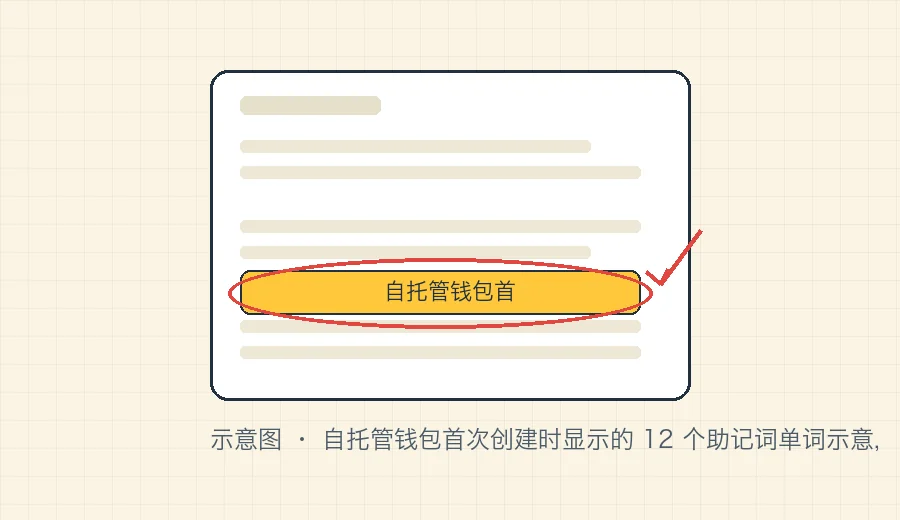
Never screenshot, photograph, save to your phone's photo album, send over chat / email, or upload to any cloud drive your seed phrase. The most reliable way is to write it neatly on paper and keep it somewhere safe. Anyone (including "support" or "technical assistance") asking you for your seed phrase is 100% a scammer, a legitimate platform will never ask you for it.
04That phrase: not your keys, not your coins
In crypto you'll surely hear this line: "not your keys, not your coins," which literally means if the keys aren't yours, the coins aren't yours.
It means: as long as the private keys aren't in your hands, your control over these coins is indirect, you're trusting the platform that holds them for you. If the platform runs into trouble, your assets could be caught up in it. The phrase is a rallying cry for self-custody supporters, reminding everyone that holding your own keys is "truly owning."
But hear it right, don't hear it wrong: it stresses understanding which trust model you're choosing, not saying exchanges are off-limits entirely. In reality, the vast majority of beginners start from an exchange, and that's fine. What matters is being clear in your own mind, leaving coins on an exchange, you trust the platform; moving to self-custody, you trust your own ability to safeguard the seed phrase. Both have a cost; pick the one that fits your current stage.
05Should a beginner use a wallet at all
My honest advice to beginners is: do it in stages.
- Just starting, small amount: maxing out the exchange account's security settings and leaving coins on a reputable exchange for now is perfectly fine. The biggest risk at this stage isn't "coins on an exchange," it's "going self-custody before you've learned to safeguard a seed phrase and losing the coins as a result."
- Assets growing, or wanting to use on-chain apps: now learn self-custody seriously, practice with a small amount first, create a wallet, write down the seed phrase, run small transfers in and out once, and only move larger amounts once you're fluent. For how to choose cold vs hot, see cold wallet vs hot wallet, which one should a beginner use.
- At any stage: thoroughly understand the concepts of seed phrase and private key first, the prerequisite for using a wallet. I strongly recommend reading what are a seed phrase and a private key first.
At bottom, wallet vs exchange isn't a single-choice question of "which is better," it's a trade-off between trust models. As a beginner, build a solid foundation first and max out security, then move to self-custody when you genuinely need it, let it come naturally. For the concept of a self-custody wallet, you can also refer to the Ethereum site's wallet introduction.
FAQFAQ
What is the core difference between a wallet and an exchange?
It comes down to one thing: who holds the private keys. On an exchange, the platform holds the keys (custodial); you log in with a username and password and the platform manages your coins. In a self-custody wallet, the keys (in seed-phrase form) are held by you; the platform can't touch your assets, but you're fully responsible for security. In a sentence: custody is handing the keys to someone else, self-custody is keeping the keys yourself.
What does "not your keys, not your coins" mean?
Literally, "if the keys aren't yours, the coins aren't yours." It means: as long as the private keys aren't in your hands, strictly speaking these coins aren't fully under your control, you're trusting the platform that holds them for you. The phrase highlights the value of self-custody, but it isn't saying coins must never sit on an exchange, rather that you should be clear about which trust model you're choosing.
Does a beginner have to use a wallet right away?
Not necessarily. For a beginner just starting out with a small amount, getting the exchange account's security set up well (2FA, anti-phishing code) and keeping coins on a reputable exchange is a common, simple way to start. Once your assets grow or you need to use on-chain apps, learning self-custody later is fine. The key is not to rashly move a large sum to your own wallet before you've understood how to safeguard a seed phrase.